Learning using design base thinking (DT) builds from the idea that learning should encourage interdisciplinary collaboration (Koria, 2015). Design thinking involves being able to address complex puzzles by involving a collaborative solution. Koria (2015) further explains that DT in its current context involves focusing and building on creativity, innovation, system thinking and utilising analytic methods for multiple contextual uses. Laurillard (2012) points out that collaborative learning focuses more on a team aspect, where individuals help build a shared public knowledge base, but most importantly through participation not just acquisition.
The core elements of design thinking should incorporate economic, environmental and social impact considerations whilst they work to understand, generate ideas and refine a design (NESA, 2017). This adds to the definition of creativity highlighted in my previous post. Design thinking is one way that could tap into the students’ ‘inner’ pool of resources – knowledge, insight, information, inspiration – and encourage them to combine these in extraordinary ways.
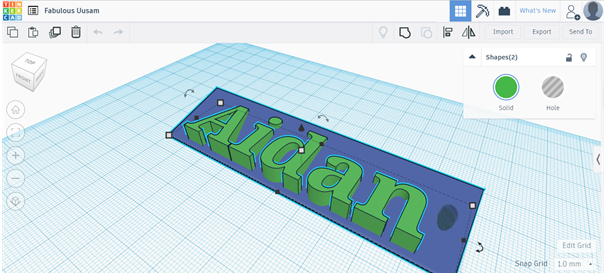
During our tutorials we experimented with ‘Tinkercad’, a 3D design program which can be used with 3D printers. Verner and Merksamer (2015) in their study found that 3D printer significantly enhances students’ practice of visual spatial skills when providing purposeful challenges. Kuo and Chang (2013) mentions that teachers often report the difficulties with students trying to visualise 3D objects with 2D models, which is why programs such as Tinkercad could be beneficial. Design thinking is difficult to learn, as well as teach; Taleyarkhan, Dasgupta, Garcia, and Magana (2018) explain design thinking skills involve an ability to tolerate ambiguity and uncertainty, convergent and divergent thinking, teamwork, and to effectively communicate ideas.
Whilst experimenting with ‘Tinkercad’ I found it was not my priority to “share my design” with peers, which to me questions how it can develop teamwork and effective communication. However, researchers have recommended the usage of CAD programs as it can contribute to student’s motivation which can be relieving to teachers by sharing some of the teacher’s responsibility to the students. CAD allows access to resources that allow students’ to virtually model, analyse, manipulate objects or concepts, and communicate with peers (Taleyarkhan, 2018).
Reference
Fronza, I., El Ioini, N., & Corral, L. (2016). Teaching Software Design Engineering Across the K-12 Curriculum: Using Visual Thinking and Computational Thinking. Proceedings of the 17th Annual Conference on Information Technology Education, 97-101.
Koria, M. (2015) Four dimensions in learning design thinking: Capabilities, constraints, collaboration, and the diffusion of ideas. Synnyt / Origins, Finnish studies in Art Education, (Special Issue: Higher Arts Education), 2, pp. 15-26.
Kuo, M., & Chuang, T. (2013). Developing a 3D Game Design Authoring Package to Assist Students’ Visualization Process in Design Thinking. International Journal of Distance Education Technologies (IJDET),11(4), 1-16.
NESA. (2017).
Science and technology K-6 syllabus (2017) [PDF]. Retrieved from
https://educationstandards.nsw.edu.au/wps/portal/nesa/k-10/learning-areas/science/science-and-technology-k-6-new-syllabus
Taleyarkhan, M., Dasgupta, C., Garcia, J., & Magana, M. (2018). Investigating the Impact of Using a CAD Simulation Tool on Students’ Learning of Design Thinking. Journal of Science Education and Technology, 27(4), 334-347. Verner, I. & Merksamer, A. (2015). Digital Design and 3D Printing in Technology Teacher Education. Procedia CIRP,36(C), 182-186.
 Fostering Digital Creativity in the Classroom